Overall verdict: at least with the mid range, they are merely okay. We’ll see about reliability yet, since I’ve bought my appliances in Q2 of 2026.
This article is mainly a collection of things I wish I had known before.
My original major appliances were made by Whirlpool, and seemed pretty reliable:
Refrigerator: Whirlpool WBE 37132 (made in 2011 in Poland, 15 years old): failed seals, progressing rust, otherwise replaced for simply being noisy.
Washing machine: Whirlpool AWE 66710 (made in 2015 in Slovakia, 10 years old): squeaky drum movement, sometimes it would go idle during operation and require un/pausing to get going again. I was longing for a washer/dryer combination, and could use a larger washing machine than this top-loader.
The main difference is that my new devices are much larger and much heavier.
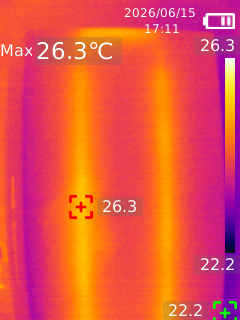
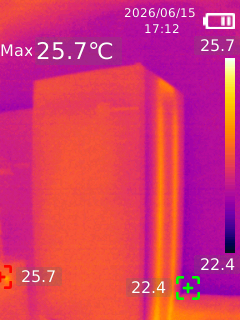
Heat is expelled through sides of the refrigerator. My thermal camera tells me there are two vertical pipes per side, joining around the top edge, that usually barely get warm (Δ3 °K, although this varies), so feel free to put stuff right next to it.
As for noise, do not expect miracles. While the inverter makes it quieter than your usual on-off compressor (BZZZZT), it rather produces this hard to localise unpleasant hum.
The fridge sports an off-centre BOSCH logo on the door that clearly wasn’t aligned properly. A sticker on a door shelf was also placed significantly askew. Finally, the left side of the otherwise grey appliance has a large sticker with factory information on it that I at the same time don’t enjoy seeing, and don’t want to remove. This thing is not made for looking at.
Since my new refrigerator for one reason or another arrived scratched to the metal in one place, I had to patch up its paint, and so I can tell you that it’s pretty close in colour to RAL 7005 Mouse Grey. The surface is glossy all over. The door looks a bit more metal-like than the sides, but it’s still some kind of textured paint rather than the stainless steel that marketing materials want to make it look like. This simplifies maintenance.
The washer arrived quite wet. I was told that’s because of factory testing.
Using the Drum Clean programme with a combination of washing powder and Vanish Oxi Action resulted in the machine completely overflowing with foam, which proceeded to ooze from the detergent drawer, as well as from around the door. So perhaps watch your dosage.
Drum movement at times makes an annoying thumping sound, otherwise the washing machine runs much quieter than my old one.
All programmes run rather long, so I’ve resorted to often using the Quick Mix hour-long one. It still works leagues better than Japanese top-loaders (40 minutes in cold water and your underwear remains dirty). The Eco 40-60 programme is apparently a result of EU regulation 2019/2023, and overall designed and then described by cretins—real temperatures stay below 40 degrees, and what you can’t choose is how much below that is.
Wiping down the door seal is a pain you must endure for choosing a front-loader. At least I can finally fit a duvet in it. It even looked like most detergent got washed out.
As relevant to your laundry, this machine only ever does one thing: spin at a constant speed in one direction without pause. In the front of it, near the door, there is a metal humidity sensor towards which your laundry is slowly pushed. If you only put small items inside, such as underwear, they will get stuck in there near the lint filter, and the dryer will finish all humidity-based programmes too early. Pausing for a few seconds will get items temporarily unstuck, but the only long-term solution is to put something large inside as well. Don’t bother with dryer balls, I’ve tried that for you.
As far as I can tell, temperatures are the same with all programmes as well. Thus we can induce that it never runs particularly hot, and that the only real distinction is whether you want a humidity-based programme, or a time-based one. The manual is unhelpful in this regard.
Installation-wise, even if you stack the dryer on top of a washing machine, you still need to loop the condensate hose around the hook near the top of the machine (exactly 80 cm high, which is within tolerance), and so you’re likely to need an extension hose—the included one is 2 metres long, which is about up and down. The wastewater merely gets warm, so you needn’t worry about suitable hose materials like I did. There’s also no great need to clamp the hose, as the pressure stays low.
When a programme starts, the machine makes a satisfying fast series of relay clicking sounds.
To install this piece, you have to pre-drill screw holes into your washing machine. While you might be worried that you’re not going to get the holes positioned correctly side-wise, in this direction it’s mostly self-positioning. Though even if you follow the manual precisely, you’re probably not going to get it right depth-wise. I was off by about 2 milimetres (placing it too far back, to give you a hint).
I love the cool white internal lighting. From the top of the fridge, and from the top of door seals.
Although this makes me unsure about what I’m paying for, these appliances do just what they need to, and aren’t packed with pointless ’smart‘ features. Perhaps it’s a result of my selection criteria, but only possible because someone still makes these like that at all.
Comments
Use e-mail, webchat, or the form below. I'll also pick up on new HN, Lobsters, and Reddit posts.